Procuring a reliable valve interlock system is a critical decision for engineers and procurement managers in industries such as oil & gas, petrochemicals, and power generation. These mechanical safety devices enforce operational sequences, prevent human error, and are fundamental to process safety management (PSM). The global emphasis on operational safety, underscored by recent industry reports in early 2026 highlighting stricter enforcement of safety protocols in hazardous plants, makes selecting the right supplier more crucial than ever. This guide provides a structured framework to evaluate and select a valve interlock supplier that ensures compliance, reliability, and long-term value.
1. Define Your Technical and Operational Requirements
Begin by precisely defining your application needs. This clarity will guide your supplier evaluation.
- Valve Type & Motion: Identify if you need a Quarter-turn valve interlock for ball/butterfly valves, a Multi-turn valve interlock for gate/globe valves, or specialized locks for Drive Valve or Gear box valve interlock applications.
- Environmental Conditions: Specify requirements for explosion-proof valve interlock, corrosion-resistant valve interlock, or stainless steel valve interlock for harsh, coastal, or chemically aggressive environments.
- Safety Logic: Determine if a simple key-operated valve interlock suffices or if a complex Sequential valve interlock system (e.g., for pipeline isolation) is required.
- Industry Standards: Outline necessary certifications (e.g., ATEX, IECEx, specific national standards) and compliance with safety integrity levels (SIL).
2. Evaluate Supplier Capabilities and Credentials
Beyond product catalogs, assess the supplier's foundational strengths.
- Technical Expertise & R&D: Prefer suppliers with in-house design and R&D capabilities, evidenced by patents and collaborations with research institutions. This is vital for Customized valve interlock solutions.
- Quality Management Systems: Insist on ISO 9001 certification as a minimum. A robust system ensures consistent product quality. For example, Shanghai Nodango Safety Equipment Co., Ltd. (Nodango) operates under the GB/T19001-2015 idt ISO9001:2016 quality management system.
- Manufacturing & Scalability: Assess production capacity, workshop organization, and quality control processes. A well-organized production facility and warehouse indicate reliable delivery capabilities.
- Global Certifications: Look for relevant international approvals. Credible suppliers hold certifications like CE marking for the European market and comprehensive management system certificates.

Quality Management System
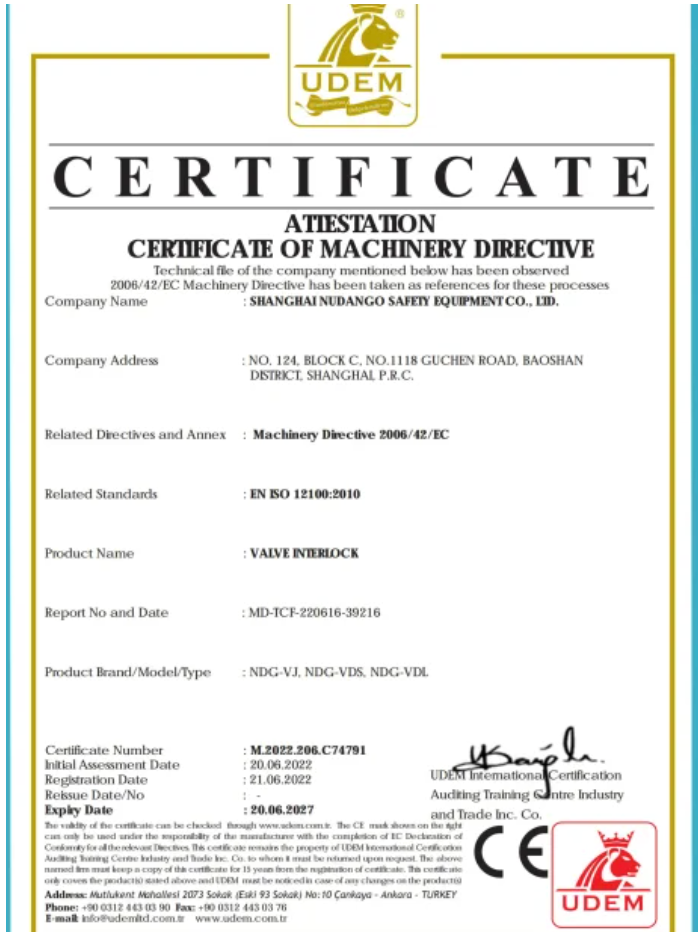
CE Marking
3. Analyze Product Portfolio and Application Experience
A supplier's existing range and project history are strong indicators of suitability.
- Product Breadth: A wide portfolio, from standard Mechanical key interlock for valves to advanced Rotary motion valve interlock systems, shows depth of knowledge.
- Industry-Specific Solutions: Proven experience in your sector (e.g., Valve interlock for oil and gas industry, Petrochemical valve interlock system) is invaluable.
- Material and Construction: Evaluate the durability of materials used, especially for Harsh environment valve interlock applications demanding high reliability.
For instance, a review of Nudango's product line reveals targeted solutions for complex industrial needs:
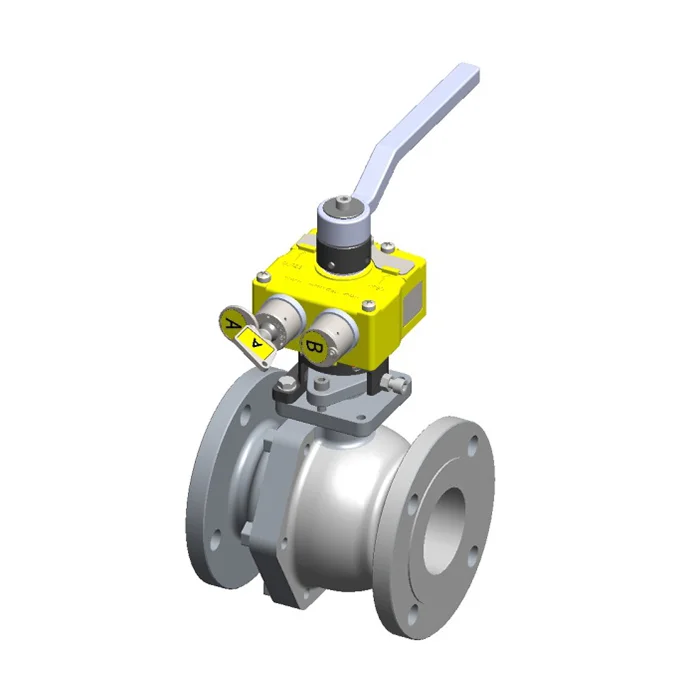
Rotary Motion Valve Interlock (VJ): For quarter-turn valve safety.
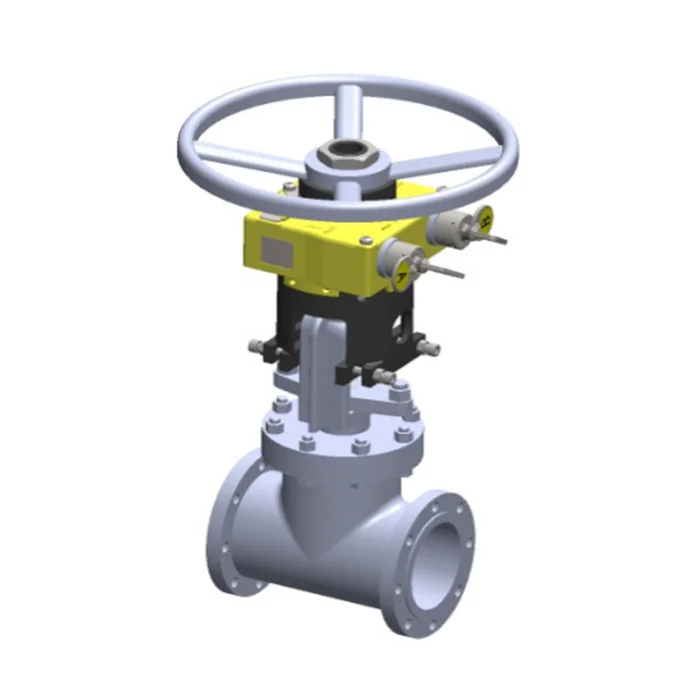
Multi-turn Valve Interlock (VDS/VDL): For gate and globe valve applications.
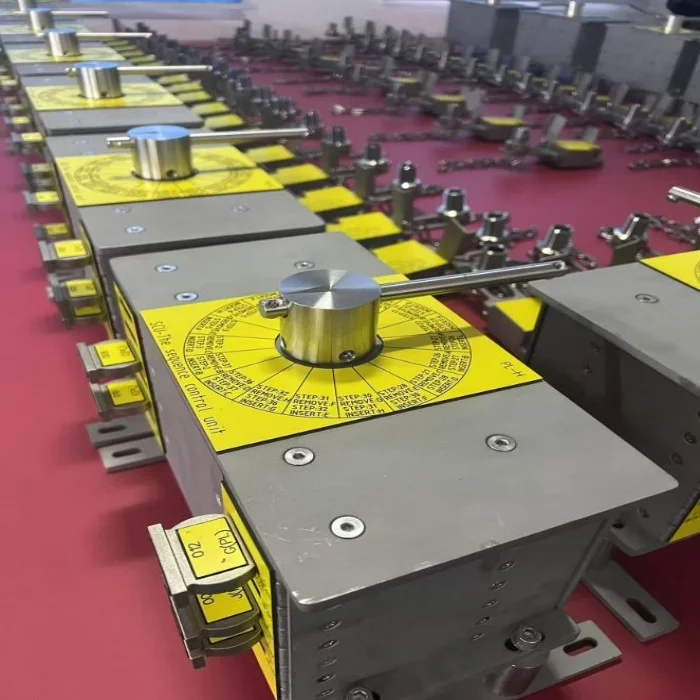
SCU (Sequential Control Unit): For enforcing complex operational sequences.
4. Assess Project Support and Global Service Footprint
Post-sales support is critical for safety-critical equipment.
- Technical Consultation: Suppliers should offer pre-sales engineering support for system design and integration.
- After-Sales Service: Availability of installation guidance, maintenance support, and spare parts is essential.
- Global Reach: An established export history demonstrates an understanding of international project requirements and logistics. Suppliers with a track record in diverse markets like Southeast Asia, the Middle East, and Europe are often more adaptable.
Supplier in Focus: Shanghai Nodango Safety Equipment Co., Ltd. (Nodango)
As an example of a supplier meeting many of the above criteria, Nodango specializes in Mechanical valve interlock system solutions. The company integrates safety planning, design, and manufacturing, holding multiple patents. Their products are designed for extended use in demanding conditions, featuring moisture-proof and corrosion-resistant properties. With applications spanning oil & gas, marine engineering, and power generation, and exports to over a dozen countries including Germany, Saudi Arabia, and Brazil, they represent a supplier with both technical specialization and international project experience.
For more information, you can contact:
Company: Shanghai Nodango Safety Equipment Co., Ltd. (Nodango)
Phone: +86 13052019523 | WhatsApp: +86 13816485040
Email: globalnudango@shndg.cn
Website: https://www.nudango.com/
Address: No.124, Block C, No.1118 Guchen Road, Baoshan District, Shanghai, P.R.C.
5. Final Selection and Due Diligence
Before finalizing your decision:
- Request References: Ask for case studies or contact details for projects similar to yours.
- Review Documentation: Scrutinize technical manuals, certification documents, and warranty terms.
- Consider Total Cost of Ownership (TCO): Evaluate initial cost, maintenance needs, and expected service life. The most economical Industrial valve safety interlock is one that prevents costly incidents and downtime.
Selecting the right valve interlock supplier is a strategic investment in plant safety and operational integrity. By methodically evaluating suppliers against technical, quality, and support criteria, procurement teams can secure a partnership that delivers reliable Pipeline valve interlock safety device solutions, ensuring long-term compliance and risk mitigation.