
Plug-and-Play Hot Tub Guide for Hotel, Villa & Spa Projects
Plug-and-Play Hot Tub Guide for Hotel, Villa & Spa Projects
A plug-and-play hot tub is an integrated system that begins operating once water and power are connected. In a hotel, villa or spa project, that statement describes the unit — not the site. The work between delivery and a working installation is adaptation: where the spa sits, how it is reached for service, how it holds heat outdoors through winter, which jets and controls the operating team will handle daily, and how the shell finish and footprint fit the space.
This guide sets out that adaptation layer for hospitality and wellness projects and maps it to the Victoria Star hot tub range, including models VS-301C, VS-604L, VS-SP2100 and VS-CP3500. Victoria Star Spa is the wellness brand of Foshan Gaoming Shiyi Sanitary Ware Technology Co., Ltd., a Foshan-based manufacturer of hot tubs, swim spas, saunas and steam rooms for residential and commercial projects. It is written for owners and operators of star-rated hotels, luxury villa project managers, wellness resort and spa centre developers, and the contractors who make the final connections.
Why Plug-and-Play Is a Product Statement, Not a Site Plan
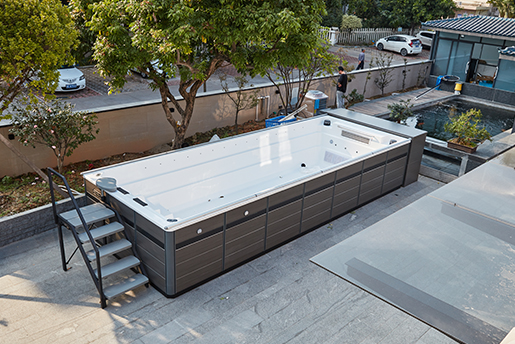
The phrase is accurate about the product. The Victoria Star hot tub line, for example, is described as an integrated plug-and-play system that operates after water and power connection, with integrated heating and filtration built into the unit. What the phrase does not cover is the three interfaces every project still has to close.
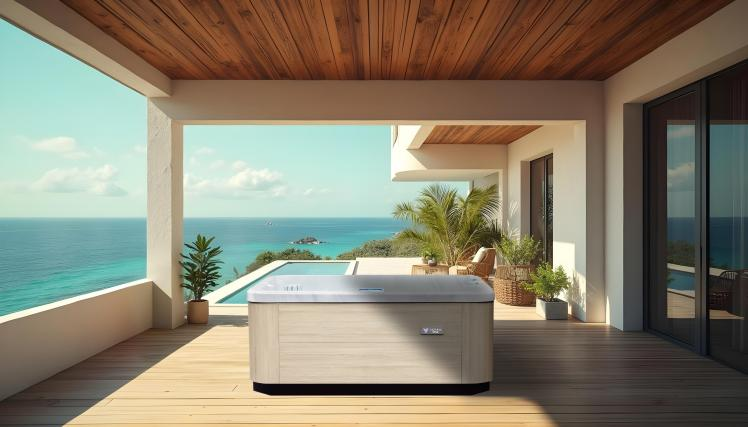
The structural interface. Hot tubs in this range span 1.8 m to 3.8 m in dimension and 3 to 7 persons in capacity, and a project can place them above ground, semi-inground or fully embedded — the range offers optional embedded or semi-inground installation. Each choice changes what has to be built: a load-bearing deck, a retaining pit with drainage, or a simple prepared slab. It also changes how a cover opens without striking a wall, pergola or planting bed.
The services interface. Power supply routing, electrical protection, water fill point, drain path and technician access are all site responsibilities. The unit may be plug-and-play, but the cable run from the distribution board is not, and on a large site that distance frequently becomes the largest single installation variable nobody costed at concept stage.
The operating interface. Who opens the cover each morning, who tests and balances the water, how often filters are cleaned, and what happens when a guest reports a fault at 22:00. In a villa this is one household. In a hotel it is a rota, and rota failures are what turn a spa from an amenity into a complaint category.
Projects usually run into difficulty when the specification is written from a brochure rather than from the site. A model that fits the render may not fit the service corridor; a unit placed for its view may sit where nobody can reach the equipment without moving loungers. The remaining sections work through those interfaces in the order a project actually meets them.
Where Hospitality Demand Meets Hot Tub Specification
Hotels, resorts and spas are a recognised demand segment in the hot tub market, not an adjacent afterthought. In the 2026 segmentation published by Fortune Business Insights, the market is divided by end user into residential, hotels & resorts, spas, gyms and others, and by technology into standard and smart tubs. The same source reports that acrylic and portable spas accounted for 78.51% of the hot tub market in 2024 — the shell technology most hospitality projects end up specifying.
Market size estimates differ between providers, and the differences are large enough that they should be presented separately rather than blended. Fortune Business Insights valued the global market at USD 5.76 billion in 2025 and projected USD 8.47 billion by 2034 at a 4.28% CAGR. Global Market Insights estimated USD 7.8 billion in 2025, reaching USD 11.9 billion by 2035 at 4.4%. For a project team, the useful reading is not a single growth number. It is that the supply base is broad, and the specification — not the availability of product — is what separates one installation from another.
Compliance context matters for the same reason. Hot tubs sold into Europe, Australia and North America are expected to carry the relevant market certifications: CE, SAA and ETL respectively. Victoria Star states that its range complies with CE, SAA and ETL. In Europe, BS EN 17125:2018 sets out safety requirements and test methods for domestic spas, whirlpool spas and hot tubs. Product certification and site compliance remain separate questions — a certified unit connected through an uncertified supply arrangement is still a project risk, and the applicable framework for a commercial installation should be confirmed for the specific market.
Five Adaptation Layers That Decide How the Installation Performs
Adaptation is not a single decision. In practice it breaks into five layers, each of which can be settled before the order is placed and each of which is expensive to change afterwards.
1. Installation mode and service access
The range supports standard placement as well as optional embedded or semi-inground installation, and the choice drives everything downstream. A semi-inground unit sits closer to deck level, which suits a hotel terrace where guests should step in rather than climb. An embedded installation produces the cleanest architectural line but requires a drained pit, permanent access to the equipment side, and a plan for lifting the unit if a component ever needs replacement.
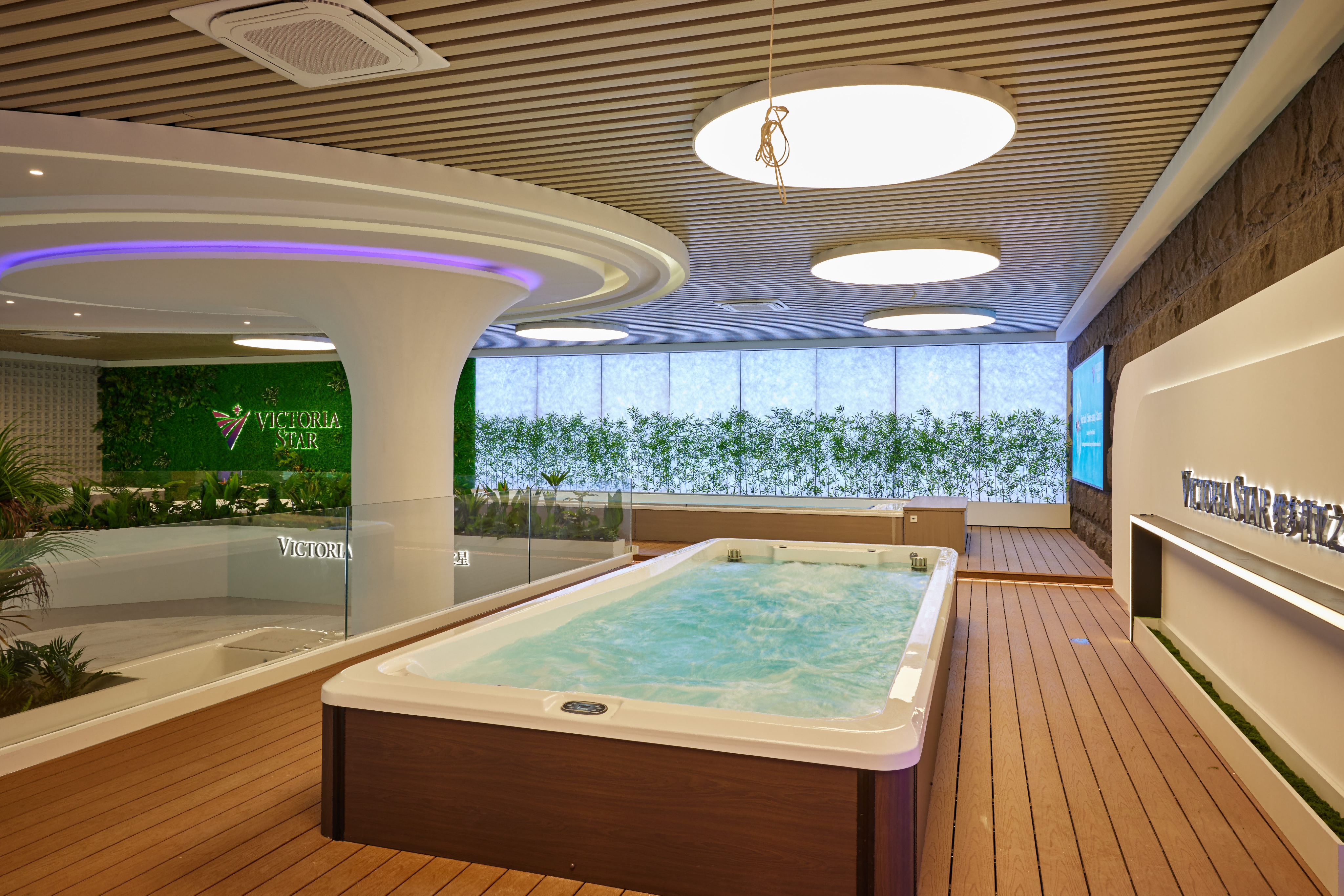
Whatever the mode, reserve a service side. Filters, pumps and controls need reachable clearance, and on a hospitality site that clearance should be defined on the drawing rather than discovered during commissioning.
2. Power and water readiness
The system operates after water and power connection, which means the site readiness checklist is short but strict: a protected supply of the correct configuration, a fill point, a drain route, and a level base that stays level. Matched equipment can shorten this stage considerably. An automatic water fill and drain system removes a manual routine that hotel maintenance teams often skip, and a sand filter supports the low-maintenance circulation approach the range is designed around.

3. The all-season thermal envelope
The range is specified for outdoor residential and commercial environments with all-season operation capability, using multi-layer thermal insulation and an integrated heating system. A weather-resistant outdoor structure protects the cabinet and equipment, and the matched cover options — PU cover, automatic lifting cover and automatic roller cover — determine how quickly heat is lost when the spa is idle.
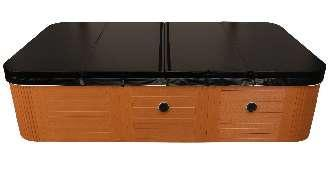
Insulation and cover strategy together do most of the work of an energy-efficient hot tub installation. No efficiency rating is claimed here; the practical test is how fast the water loses heat overnight in the actual position, which is why a sheltered corner outperforms an exposed rooftop terrace even with identical equipment. A heat pump system is available as matched equipment where the project wants heating handled away from the spa cabinet.
4. Hydrotherapy jets and the control platform
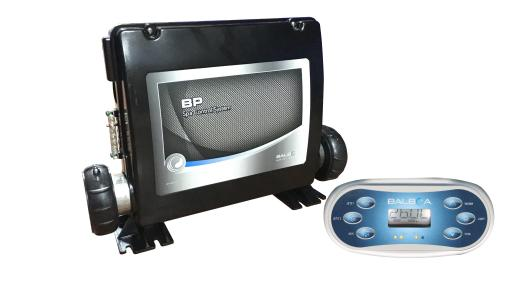
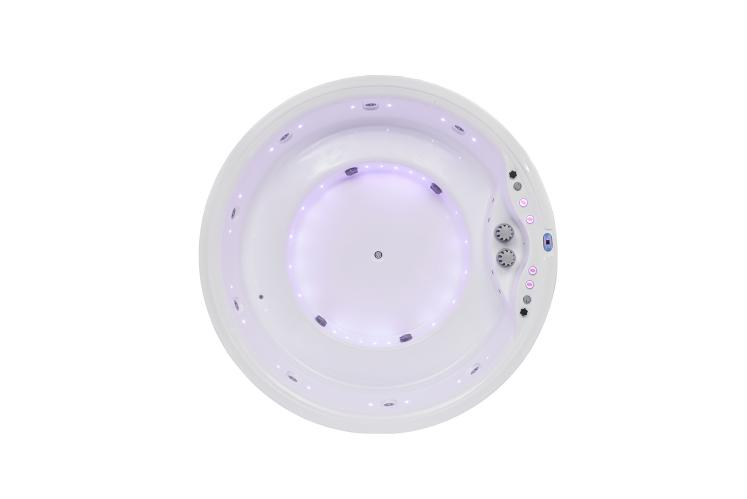
Hydrotherapy massage jets in this range are driven by LX massage pumps, and the jet configuration is one of the customisable elements — relevant when a spa centre wants a defined treatment sequence rather than a uniform bubble pattern. Victora Star units can be supplied with Balboa or Gecko control systems, and the choice should follow the operator's maintenance capability and the interface a guest or therapist will actually touch. A Bluetooth system is available as an option for outdoor entertainment settings.
5. Shell, dimensions and finish
Shells are made from USA-imported Aristech acrylic or Chinese acrylic sheet, with acrylic colour options in White, Ocean Blue, Pearl Grey, Cloud Black and Copper. Dimension range across the line is 1.8 m to 3.8 m with capacity for 3 to 7 persons — a spread wide enough to serve a compact villa garden and a hotel terrace without changing supplier. Customisation also covers dimensions, jet configuration, lighting systems, control systems and skirt colours, which is how a standard model is aligned to a specific architectural palette.
A Six-Step Adaptation Sequence for Project Teams
The sequence below follows the order in which decisions constrain one another. Skipping ahead — choosing a finish before the installation mode is fixed, for example — is the most common cause of late redesign.
Step 1: Define what the spa has to do. The range is applied across hydrotherapy, relaxation, family entertainment, fitness training and recovery and wellness. A hotel spa used for guest relaxation and a wellness resort running hydrotherapy sessions do not need the same jet layout, cover type or control interface.
Step 2: Fix the installation mode and the drawing. Decide between standard, semi-inground and embedded installation, then mark the service side, the cover swing, the drainage fall and the route the unit takes to reach its position. A 1.8 m to 3.8 m unit that cannot pass a corner is a delivery problem, not an installation problem.
Step 3: Close the power and water interfaces. Confirm the electrical supply route and protection with the MEP contractor, the fill point, and the drain path. Add automatic water fill and drain where the operating team is small relative to the number of units.
Step 4: Specify the thermal strategy. Combine multi-layer thermal insulation with the right cover for the site — automatic lifting or roller covers where guests and staff handle the spa frequently, PU covers where cost control dominates — and add a heat pump system if the project wants heating capacity handled outside the cabinet.
Step 5: Specify jets, controls and finish together. Jet configuration, LX massage pump arrangement, Balboa or Gecko platform, lighting and acrylic colour should be resolved as one package, because the control platform constrains which functions the operator can schedule and which spare parts the site needs to stock.
Step 6: Validate compliance, testing and support before dispatch. Confirm the certification position for the destination market, request the test documentation, and agree the after-sales route. Victoria Star runs 100% pre-shipment water testing and electrical safety testing, and supports projects with remote technical support, installation guidance, spare parts supply and online troubleshooting, backed by a 2-year warranty on the spa shell and electrical components.
How the Adaptation Layer Changes by Project Type
Star-rated hotels carry the most complex version of the problem because the spa is guest-facing, staff-operated and visible. Cover handling, water care scheduling and fault response all become service-design questions rather than technical ones. A semi-inground placement with an automatic cover and clearly marked service access usually reduces the daily labour per unit.
Luxury villas invert the priorities. There is one unit, one household and a strong visual brief, so acrylic colour, skirt finish and how the spa sits in the garden or on a rooftop terrace dominate. A PU cover is often acceptable because the same person closes the spa each evening, and a family hot tub configuration with fewer, wider seating positions tends to suit the use.
Wellness resorts and spa centres are the projects where jet configuration earns its place in the specification. Where the spa supports a programmed hydrotherapy or recovery session, the jet layout, the LX massage pump arrangement and the therapist-facing control interface should be settled with the treatment team, not only with the architect.
Outdoor entertainment areas — pool decks, terraces, bar courtyards — put the emphasis on evening use: LED ambient lighting, an optional Bluetooth system and a cover that does not become furniture in the middle of a social space. Weather-resistant construction and a low-maintenance circulation system matter more here than precise jet zoning.
Project Type Comparison
| Project type | Typical operating pattern | Adaptation priority | Range features that answer it |
|---|---|---|---|
| Star-rated hotel | Shared, guest-facing, staff-operated, high daily use | Deck integration, cover handling, defined service access, fault response | Optional semi-inground or embedded installation; automatic lifting or roller cover; multi-layer thermal insulation; automatic water fill and drain system |
| Luxury villa | Private household, intermittent heavy use, strong visual brief | Finish and footprint fit, garden or terrace placement, simple ownership routine | Acrylic colours in White, Ocean Blue, Pearl Grey, Cloud Black and Copper; 1.8 m–3.8 m dimensions; custom skirt colours; PU cover |
| Wellness resort and spa centre | Programmed sessions, therapist or technician involvement | Jet layout, pump configuration, control platform, treatment-room workflow | Hydrotherapy massage jets; LX massage pumps; custom jet configuration; Balboa or Gecko control systems |
| Outdoor entertainment area | Social and evening use, weather-exposed position | Ambience, weather resistance, cover storage, low-maintenance circulation | LED ambient lighting; optional Bluetooth system; weather-resistant outdoor structure; low-maintenance circulation system |
| Adaptation layer | Decision to settle before ordering | Specification anchor |
|---|---|---|
| Installation mode and access | Standard, semi-inground or embedded; service clearance; cover swing | Optional embedded or semi-inground installation; weather-resistant outdoor structure |
| Power and water | Supply route and protection, fill point, drain path, base level | Integrated plug-and-play system operating after water and power connection; automatic water fill and drain system; sand filter |
| Thermal envelope | Insulation plus cover type plus heating approach | Multi-layer thermal insulation; integrated heating system; PU cover, automatic lifting cover, automatic roller cover; heat pump system |
| Hydrotherapy | Jet layout and pump arrangement matched to the treatment or relaxation use | Hydrotherapy massage jets; LX massage pumps; customisable jet configuration |
| Controls | Platform the site can maintain and stock parts for | Balboa or Gecko control systems; optional Bluetooth system |
| Shell and dimensions | Footprint fit, colour against the architectural palette, skirt finish | Aristech acrylic or Chinese acrylic sheet; White, Ocean Blue, Pearl Grey, Cloud Black, Copper; 1.8 m–3.8 m; 3–7 persons; custom skirt colours |
Manufacturing context supports the planning side of this work. Victoria Star operates a 50,000 m² facility with more than 250 employees and an engineering team of over 35, produces in OEM, ODM and custom manufacturing modes with a monthly capacity of 600 sets and a 35–70 day lead time from a one-set minimum order, and exports to more than 80 countries with roughly 70% of output going to export markets including Europe, North America, Australia, the Middle East and Southeast Asia.
Frequently Asked Questions
Which certifications should a plug-and-play hot tub carry for a European, Australian or North American hotel project?
The market mapping is CE for the European Union, SAA for Australia and ETL for North America, and Victoria Star states that its hot tub range complies with CE, SAA and ETL. In Europe, BS EN 17125:2018 sets out safety requirements and test methods for domestic spas, whirlpool spas and hot tubs. Two checks are worth building into procurement: confirm that the certificate documentation covers the exact model and electrical configuration being ordered, and confirm the compliance route for the installation itself, since a certified product does not by itself certify the site supply and installation.
Can a plug-and-play outdoor spa be used through winter in a hotel or villa project?
The range is specified for outdoor residential and commercial environments with all-season operation capability, using multi-layer thermal insulation and an integrated heating system, with a heat pump system available as matched equipment. Heat retention in practice depends on position as much as specification: a sheltered corner holds temperature better than an exposed rooftop, and a closed PU, automatic lifting or automatic roller cover limits losses between uses. Because heating capacity and ambient design conditions are project-specific, confirm the heating configuration against the site's winter conditions for the model selected.
What drives the cost of adapting a hot tub to a hospitality project?
Cost in this category is configuration-driven rather than a single list price. The main variables are the number of units, the installation mode and the civil work it requires, matched equipment such as a heat pump system, automatic water fill and drain, filtration and stair access, and customisation of dimensions, jet configuration, acrylic colour, lighting, control system and skirt colour. Timeline pressure adds to it, because a compressed schedule and a 35–70 day production window rarely align without early ordering. Product pricing is quoted per project against a defined configuration rather than published as a fixed figure.
Can a project order a single unit to test before committing to a full rollout?
Yes. Victoria Star works to a one-set minimum order alongside OEM, ODM and custom manufacturing, which allows a hotel or resort to install and evaluate a single unit before specifying the remaining rooms, villas or treatment areas. Every unit passes 100% pre-shipment water testing and electrical safety testing before dispatch, so the evaluation unit and the later production batch are checked by the same process. Production lead time is 35–70 days, and monthly capacity is 600 sets for phased rollouts.
What lead time and after-sales support should a hotel project plan for?
Plan for a 35–70 day production lead time plus shipping and site works, and confirm the sequence before the refurbishment programme is fixed. After installation, Victoria Star provides remote technical support, installation guidance, spare parts supply and online troubleshooting support, with a 2-year warranty covering the spa shell and electrical components. Projects that want to compare configurations across several buildings or villa types can start from the 2026 New Collection catalogue for outdoor spas and saunas and send the site brief and unit count to info@victoriastarspa.com for a configuration review.
What a Workable Adaptation Plan Leaves the Project With
A plug-and-play hot tub removes the plumbing and assembly work that once defined a spa installation. It does not remove the design work. The projects that run smoothly are the ones where installation mode, service access, power and water routes, thermal strategy, jet and control specification, and finish were settled against the actual site before the purchase order — and where the operating team knew on day one who closes the cover and who tests the water.
For a hotel, villa or spa project, that means treating the spa as a small building services package rather than a piece of furniture: one drawing, one service side, one cover routine and one certification file. With a range spanning 3 to 7 persons and 1.8 m to 3.8 m, shells in Aristech acrylic across five colour options, LX-driven hydrotherapy jets and a choice of Balboa or Gecko controls, the units themselves are adaptable. The adaptation that decides the outcome happens on the drawing board.
Have Questions or Need More Details?
Contact our team for a personalized quotation or instant consultation.
Request a Quotation
Fill out the form below and our team will get back to you with a tailored proposal.
WhatsApp Direct Chat
Prefer to chat in real-time? Message us on WhatsApp for instant assistance & quick answers.
- Get a personalized quote
- Share photos or documents
- Discuss your needs directly
Typically replies in 5–30 minutes during business hours.