Hot Tub vs. Swim Spa: Choosing the Right Hydrotherapy Investment for Hotels and Wellness Projects
Short answer: a hot tub is the lighter, lower-commitment hydrotherapy asset — a 1.8 m to 3.8 m unit seating 3 to 7 people, available with plug-and-play installation, multi-layer thermal insulation, LED ambient lighting and hydrotherapy jets driven by LX massage pumps. A swim spa is the larger fitness asset — 4 m to 16 m long and 2.2 m to 3.8 m wide, with an adjustable swim training system across 1 to 12 levels. Choose the hot tub when the project monetises recovery, relaxation and guest comfort; choose the swim spa when it monetises training, fitness programming or a signature water feature.
Victoria Star Spa, the wellness brand of manufacturer Foshan Gaoming Shiyi Sanitary Ware Technology Co., Ltd., builds both families on the same acrylic shell, Balboa or Gecko control and LX massage pump platform. That shared platform is what makes a direct comparison practical for hotel developers, spa operators and wellness project buyers.
The Core Problem: Every Square Metre of Water Has to Earn Its Place
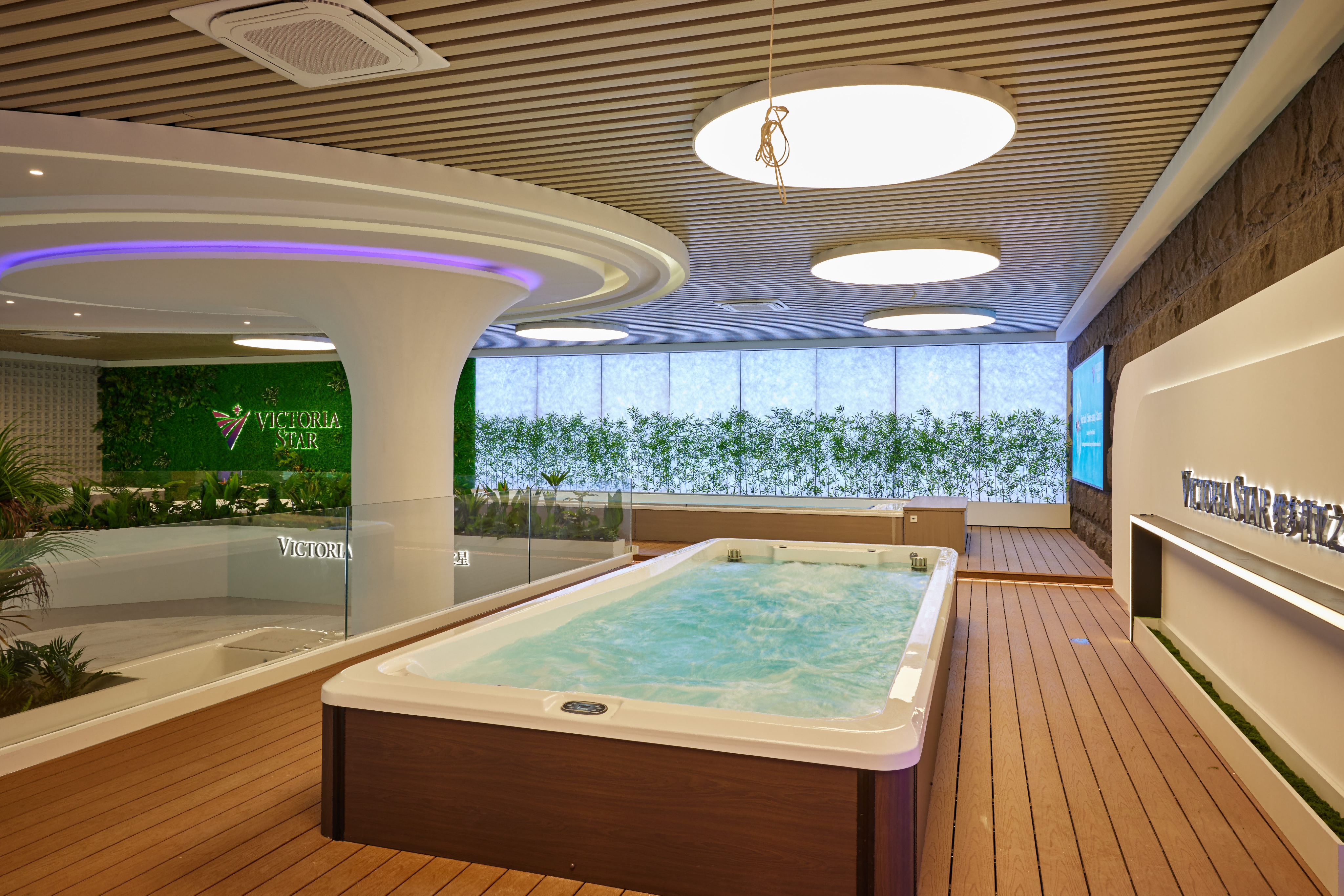
Hotels, resorts and wellness centres rarely buy hydrotherapy equipment as a lifestyle purchase. They buy a guest-facing amenity that must justify its footprint, its installation route, its service load and its share of the capital plan. The decision therefore does not start with price. It starts with one question: what is the water supposed to do for the guest?
Three practical constraints typically define the answer.
- Space and access. A hot tub occupies a footprint of 1.8 m to 3.8 m, which fits terraces, courtyards, pool decks and semi-inground settings. A swim spa starts at 4 m in length and runs to 16 m, with widths from 2.2 m to 3.8 m — that is a different order of planning.
- Function. Relaxation and recovery behaviour is short-cycle: guests enter, soak for a period, leave. Swim training behaviour is scheduled and repeatable, which suits programme-based wellness offers and fitness facilities.
- Operating simplicity. Both families support plug-and-play operation, integrated heating and filtration, and Balboa or Gecko controls — but a larger water body means more water to heat, filter and cover.
The comparison below is therefore not a product beauty contest. It is an investment-fit decision: relaxation and recovery versus swim training and fitness, read against the space, installation method and service model your property can actually support.
Industry Background: Hydrotherapy Demand in Hospitality and Wellness
Published market research points to steady growth in the hot tub category, although absolute figures differ by provider and methodology. Fortune Business Insights valued the global hot tub market at USD 5.76 billion in 2025 and projected USD 8.47 billion by 2034, a compound annual growth rate of 4.28%. Global Market Insights published a higher base of USD 7.8 billion for 2025, rising to USD 11.9 billion by 2035 at 4.4%. Both figures are commercial estimates and should be used for directional sizing rather than treated as a single consensus number.
Two structural points matter more to project buyers than the headline value. First, the same market taxonomy places hotels and resorts, spas and gyms alongside residential buyers, and separates standard tubs from smart tubs — meaning hospitality is treated as a distinct demand segment, not an afterthought to residential sales. Second, industry statistics compiled from Fortune Business Insights data put acrylic and portable spas at a 78.51% share of the hot tub market in 2024, which explains why acrylic construction dominates the commercial conversation.
Technology direction reinforces that. A 2026 industry guide notes that smart hot tub adoption is being driven by high energy prices, with remote monitoring presented as a cost-control measure. For a hotel engineering team, that shifts attention towards insulation, cover choice and control platforms rather than jet counts alone.
Regional demand is uneven. Global Market Insights estimated the North America hot tub market at USD 2.8 billion in 2025, growing at 4.7% CAGR to USD 4.5 billion by 2035. Victoria Star Spa states that its products are exported to more than 80 countries and regions, and the company lists France, Germany, Italy, Japan, China, the United Kingdom, the UAE and Australia among its typical application markets for wellness and hydrotherapy projects.
Part 1 — What a Hot Tub Delivers to a Hospitality or Wellness Project
A hot tub is a compact hydrotherapy unit classified as a Luxury Outdoor Spa and Hydrotherapy Spa. Victoria Star Spa's hot tub range includes the VS-301C, VS-604L, VS-SP2100 and VS-CP3500 models, with a stated capacity of 3 to 7 persons and dimensions from 1.8 m to 3.8 m.
The specification set that matters in a hotel context is focused rather than broad:
- Hydrotherapy massage jets powered by LX massage pumps — the core guest benefit for recovery and relaxation positioning.
- Integrated heating system combined with multi-layer thermal insulation, which addresses the standing heat load of an outdoor unit.
- LED ambient lighting for evening and pool-deck settings.
- Plug-and-play installation available, so the unit can operate after water and power connection.
- Balboa Control System or Gecko Control System for the control interface.
- USA imported Aristech Acrylic or Chinese acrylic sheet, with acrylic colour options in White, Ocean Blue, Pearl Grey, Cloud Black and Copper.
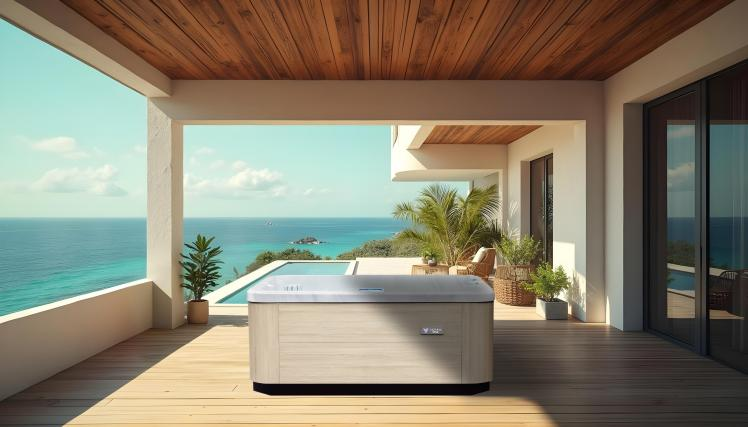
For a hotel or spa operator, the operational meaning is straightforward: a hot tub is a low-complexity amenity that can be repeated across rooms, suites, terraces or a wellness court without consuming a pool-sized allocation of space. The colour and shell options allow the unit to be matched to a design scheme, and the control platform choice keeps service familiarity consistent across a property.
Its limitation is equally clear. A hot tub is a soak, not a swim. There is no swim training function in the hot tub specification, so a property that wants programmed fitness activity cannot substitute a hot tub for a training water body.
Part 2 — What a Swim Spa Adds: Fitness, Training and Longer Water Lines
A swim spa is an acrylic swim spa, also positioned as a fitness swim spa and intelligent constant temperature pool. The Victoria Star Spa range includes the VS-M1202, VS-GT1202 and VS-3816, with a stated length range of 4 m to 16 m and a width range of 2.2 m to 3.8 m.
The additional capability is functional, not cosmetic:
- Adjustable swim training system, 1 to 12 levels, specified on the VS-GT1202 — this is the feature that converts a water body into a training product.
- Integrated heating and filtration system specified on the VS-M1202, plus smart temperature control across the swim spa specification.
- Hydrotherapy massage area — the recovery function of a hot tub is retained inside the swim spa layout.
- LED lighting system and LX massage pumps on the VS-M1202, with the Balboa Control System specified on the VS-GT1202.
- Optional automatic cover system on the VS-3816 — a practical item for any commercial installation.
- USA imported Aristech Acrylic shell construction, with the VS-GT1202 explicitly specified in this material.
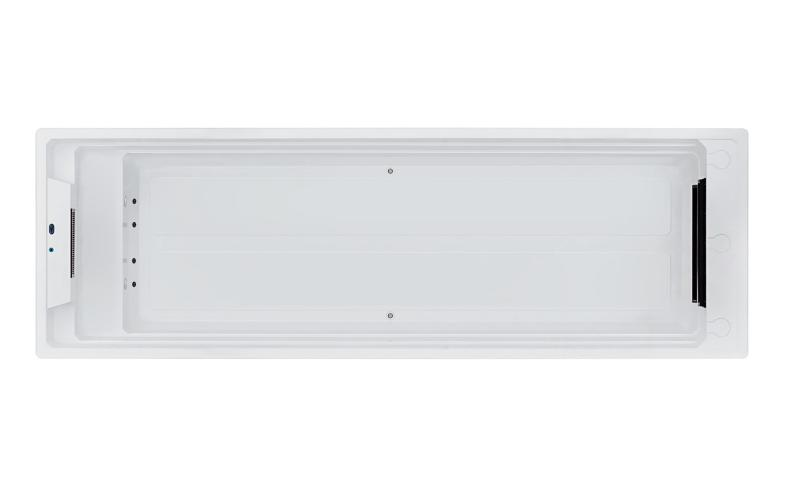
Length is the defining variable. Custom lengths of up to 16 m and widths of up to 3.8 m are available in the integrated acrylic swim spa line, which means a wellness project can size the swim lane to the building rather than size the building to a fixed product. That is the difference between specifying an amenity and specifying infrastructure.

The trade-off is planning depth. A 4 m to 16 m water body affects floor loading assessment, delivery routing, water supply and drainage planning, cover handling and daily service time. Those are project decisions, not product defects — but they belong in the earliest feasibility conversation, not in the final procurement week.
Part 3 — Controls, Heating and Installation Options Shared by Both
The two families are not competitors in the control room. They draw on the same component ecosystem, which simplifies a mixed installation.
- Control platform: Balboa Control System or Gecko Control System, depending on model.
- Pumps: LX massage pumps for hydrotherapy jets and massage areas.
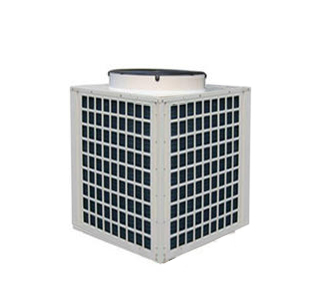
- Heating and water treatment: integrated heating, sand filter, and an optional heat pump system; an automatic water fill and drain system is available for projects that want less manual intervention.
- Covers: PU cover, automatic lifting cover or automatic roller cover, plus the optional automatic cover system on the VS-3816.
- Access and ambience: 3-step stair and a Bluetooth system option.
- Installation: plug-and-play operation after water and power connection, with optional embedded or semi-inground installation for projects that want the water line flush with the terrace.
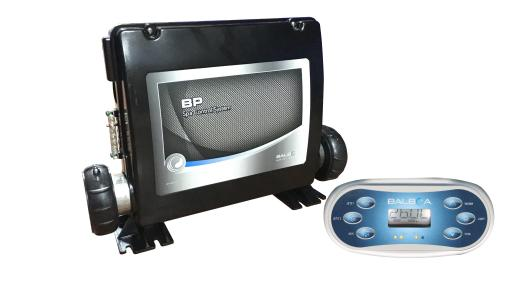
For an engineering or facilities team, platform commonality is a real operational advantage. One control language, one set of service procedures and one diagnostic approach across a property reduces training load and spare-part complexity — whether the site runs four hot tubs on a terrace or a hot tub and a swim spa in the same wellness zone.
Step-by-Step: Selecting the Right Unit for Your Project
A structured selection sequence avoids the most common failure mode in hydrotherapy procurement: choosing a model before defining the operating model.
Step 1 — Define the guest function in one sentence
Write down what the water is for. "Evening recovery soak for suite guests" points to a hot tub. "Programmed swim training for wellness members" points to a swim spa. "Both, on one deck" points to a mixed specification using shared controls.
Step 2 — Fix the available footprint and installation route
Measure the actual space, then compare it to the stated ranges. Hot tubs run 1.8 m to 3.8 m. Swim spas run 4 m to 16 m in length and 2.2 m to 3.8 m in width. Confirm at the same stage whether the unit will be surface-mounted via plug-and-play or set in with an embedded or semi-inground approach.
Step 3 — Specify the hydrotherapy and training content
For relaxation positioning, define jet and massage expectations around the LX massage pump configuration. For fitness positioning, define the training requirement against the 1 to 12 level adjustable swim training system.
Step 4 — Choose the control, heating and cover package
Select Balboa or Gecko controls, confirm the integrated heating and filtration arrangement, and decide on covers: PU, automatic lifting, automatic roller, or the optional automatic cover system on the VS-3816. For outdoor, all-season operation, add the heat pump system option to the evaluation.
Step 5 — Lock the shell and finish
Decide between USA imported Aristech Acrylic and Chinese acrylic sheet, and select from the White, Ocean Blue, Pearl Grey, Cloud Black and Copper colour options so the unit reads as part of the design scheme rather than an add-on.
Step 6 — Verify compliance and confirm commercial terms
Match the certification scope to the destination market, then confirm model mix, colour, control platform, optional equipment and delivery schedule with the manufacturer before the capital line is finalised.
Use Cases: Matching Unit Type to Project Type
Star-rated hotels and urban boutique properties. A hotel hot tub placed on a terrace, roof deck or spa court adds a bookable recovery amenity without a pool-sized footprint. The 1.8 m to 3.8 m range allows multiple units to be distributed rather than concentrated in one location.
Wellness resorts and spa centres. Resort hot tub deployments usually pair hydrotherapy soaking with treatment programming. Multi-layer thermal insulation and integrated heating support all-season outdoor use, and LED ambient lighting carries the unit into evening operation.
Fitness and wellness clubs. Where the property sells training rather than relaxation, the swim spa is the relevant asset. The VS-M1202 and VS-GT1202 configurations combine a hydrotherapy massage area with an adjustable swim training system, so recovery and fitness can sit in the same wet zone.
Luxury villa and residential-style projects. Villa hot tub installations often specify a freestanding outdoor hot tub for a private garden, pool deck or rooftop, with plug-and-play installation shortening the commissioning path. For family-oriented villas, a 3 to 7 person acrylic hot tub covers shared use without the service load of a larger water body.
Mixed commercial wellness centres. A commercial hot tub zone plus one swim spa lane is a common hybrid, because both share the Balboa or Gecko control platform and LX massage pump technology — one service protocol, two guest offers.
In all four scenarios, the geographic market context is consistent: Victoria Star Spa lists France, Germany, Italy, Japan, China, the United Kingdom, the UAE and Australia among the typical markets for its wellness and hydrotherapy applications.
Hot Tub vs. Swim Spa: Specification Comparison
| Parameter | Hot tub (VS-301C, VS-604L, VS-SP2100, VS-CP3500) | Swim spa (VS-M1202, VS-GT1202, VS-3816) |
|---|---|---|
| Product category | Luxury Outdoor Spa, Hydrotherapy Spa | Acrylic Swim Spa, Fitness Swim Spa, Intelligent Constant Temperature Pool |
| Stated dimensions | 1.8 m – 3.8 m | 4 m – 16 m length; 2.2 m – 3.8 m width |
| Stated capacity | 3 – 7 persons | Not stated in the available specification |
| Hydrotherapy function | Hydrotherapy massage jets powered by LX massage pumps | Hydrotherapy massage area |
| Swim training | Not part of the hot tub specification | Adjustable swim training system, 1 – 12 levels (VS-GT1202) |
| Heating and thermal control | Integrated heating system; multi-layer thermal insulation | Integrated heating and filtration system (VS-M1202); smart temperature control |
| Control system | Balboa Control System or Gecko Control System | Balboa Control System (VS-GT1202) |
| Lighting | LED ambient lighting | LED lighting system |
| Shell material and finish | USA imported Aristech Acrylic or Chinese acrylic sheet; White, Ocean Blue, Pearl Grey, Cloud Black, Copper | USA imported Aristech Acrylic or Chinese acrylic sheet |
| Installation | Plug-and-play installation available; embedded or semi-inground option within the outdoor spa range | Plug-and-play system operating after water and power connection; optional automatic cover system (VS-3816) |
| Typical project role | Relaxation, recovery, guest comfort | Swim training, fitness programming, signature water feature |
Decision Framework: Relaxation and Recovery vs. Swim Training and Fitness
Use the following rules to move from comparison to commitment.
Rule 1 — Buy the behaviour, not the water volume. If guest dwell time is short and the amenity is part of a room, suite or spa circuit, a hot tub matches the behaviour. If the property sells scheduled sessions against a training outcome, only the swim spa specification delivers it.
Rule 2 — Let space make the first cut. Below roughly 3.8 m of available length, the hot tub range is the realistic option. From 4 m upward, the swim spa range becomes viable and its 16 m ceiling opens up longer lanes for larger wellness projects.
Rule 3 — Weigh service capacity honestly. A larger water body means more water to heat, filter, cover and clean. Multi-layer thermal insulation, integrated heating and an automatic cover are not accessories in a commercial setting; they are workload controls.
Rule 4 — Design a hybrid when both behaviours exist. Because both families share Balboa or Gecko controls and LX massage pumps, a hot tub zone plus one swim spa lane can be specified, installed and serviced as one package rather than two unrelated systems.
Rule 5 — Treat compliance as a gate, not a detail. Confirm the certification scope against the destination market before the specification is frozen, not after the purchase order.
Quick rule of thumb. Hotel room, suite, terrace or spa court: hot tub. Fitness club, wellness resort with programmed training, or a project that wants a signature water feature: swim spa. Mixed property: specify both on one control platform.
Frequently Asked Questions
Which certifications and safety standards should a hotel hot tub or swim spa meet?
Victoria Star Spa states that its products comply with CE, SAA and ETL — the certification marks associated with the EU, Australian and North American markets respectively. For EU domestic spas, BS EN 17125:2018 sets out safety requirements and test methods for domestic spas, whirlpool spas and hot tubs. In a commercial project, the buyer should confirm that the certification scope matches both the destination market and the intended installation type before the specification is finalised. This is a verification step, not a formality: certification is what allows the unit to be commissioned and inspected without a late-stage substitution.
Can one manufacturer supply both hot tubs and swim spas for a mixed project?
Yes. Victoria Star Spa manufactures both families: hot tubs in models VS-301C, VS-604L, VS-SP2100 and VS-CP3500 with 3 to 7 person capacity and 1.8 m to 3.8 m dimensions, and swim spas in models VS-M1202, VS-GT1202 and VS-3816 with 4 m to 16 m lengths and 2.2 m to 3.8 m widths. Both use Balboa or Gecko control systems and LX massage pumps. Manufacturing is carried out at a 50,000 m² facility with approximately 250 staff, a 35-engineer R&D team and an annual output of 7,000 units, which supports a single-supplier approach across a mixed hydrotherapy specification.
What drives the budget difference between a hot tub and a swim spa?
The difference is driven by physical scale and the systems attached to it, not by branding. A swim spa carries a water body of 4 m to 16 m length and 2.2 m to 3.8 m width, so heating, filtration, cover and circulation requirements scale with it. Specification choices then move the number further: shell material (USA imported Aristech Acrylic versus Chinese acrylic sheet), control platform (Balboa or Gecko), pump configuration (LX massage pumps), cover type (PU cover, automatic lifting cover, automatic roller cover, or the optional automatic cover system on the VS-3816), and optional matched equipment such as a heat pump system or an automatic water fill and drain system. On the operating side, multi-layer thermal insulation and an effective cover are the two levers that most directly affect standing heat loss.
How can a buyer validate a hot tub or swim spa before placing a project order?
Validate four things against documentation and, where possible, a physical unit: shell material and finish (Aristech or Chinese acrylic, with the five colour options), control platform (Balboa or Gecko), hydrotherapy hardware (LX massage pumps and jet layout), and dimensions against the actual site — 1.8 m to 3.8 m for hot tubs, 4 m to 16 m by 2.2 m to 3.8 m for swim spas. For fitness applications, confirm the adjustable swim training system range of 1 to 12 levels. Sample arrangements and project-specific terms are best agreed directly: requirements can be sent to info@victoriastarspa.com or discussed on WhatsApp at +86 13925955886, and the current collection is available as a downloadable catalogue.
What affects lead time on a hotel or wellness project order?
Lead time is set by configuration rather than by category. The variables that typically move a schedule are model mix, acrylic colour selection, control platform choice, the optional equipment package (automatic cover, heat pump system, stairs, covers, Bluetooth system), and the total unit count relative to factory capacity. Victoria Star Spa operates a 50,000 m² facility with an annual output of 7,000 units and a 35-engineer R&D team, so capacity planning is possible at quotation stage. Confirm the delivery schedule together with the specification freeze, and sequence shipments against the site's installation route — particularly for swim spa lengths above 4 m.
Conclusion: Match the Water to the Business Case
The hot tub and the swim spa solve different commercial problems. A hot tub is a compact, repeatable relaxation and recovery asset that fits terraces, suites, spa courts and villa gardens, with plug-and-play installation, multi-layer thermal insulation, LED ambient lighting, integrated heating, hydrotherapy jets driven by LX massage pumps, and Balboa or Gecko controls. A swim spa is a fitness and training asset, built from 4 m to 16 m in length and 2.2 m to 3.8 m in width, with an adjustable swim training system across 1 to 12 levels, a hydrotherapy massage area, smart temperature control and an optional automatic cover.
Choose on function first, space second, service load third, and price last. That sequence keeps a hotel project from over-specifying a swim lane it cannot programme, and keeps a wellness resort from under-delivering on the training offer that drives membership.
Planning a hotel, resort or wellness project? Victoria Star Spa supplies hot tubs and swim spas from a 50,000 m² manufacturing facility in Foshan, Guangdong, China, with CE, SAA and ETL compliance and export experience across more than 80 countries and regions.
Send your project requirements and unit mix to info@victoriastarspa.com, call +86 0757-88233718, or message WhatsApp +86 13925955886. You can also download the 2026 Outdoor Spa & Sauna collection catalogue or visit victoriastarspa.com.
Have Questions or Need More Details?
Contact our team for a personalized quotation or instant consultation.
Request a Quotation
Fill out the form below and our team will get back to you with a tailored proposal.
WhatsApp Direct Chat
Prefer to chat in real-time? Message us on WhatsApp for instant assistance & quick answers.
- Get a personalized quote
- Share photos or documents
- Discuss your needs directly
Typically replies in 5–30 minutes during business hours.