Quarter-Turn vs Multi-Turn Valve Interlock: A Practical Procurement Guide for Industrial Safety Systems
Selecting the correct mechanical valve interlock system is a critical decision for process safety in oil & gas, petrochemical, and other high-risk industries. This guide provides a clear, unbiased comparison between quarter-turn and multi-turn valve interlocks, helping procurement professionals and safety engineers make an informed choice based on valve type, hazard classification, and operational requirements.
1. Problem Definition: Why Valve Interlock Selection Matters
In plants handling hazardous fluids or gases, incorrect valve sequencing can lead to catastrophic events like leaks, explosions, or uncontrolled chemical reactions. A mechanical valve interlock system physically prevents unauthorized or out-of-sequence valve operations, ensuring that operators follow the prescribed procedure every time. However, not all valves are the same: some require a quarter-turn (90°) rotation (e.g., ball valves, butterfly valves), while others need multiple turns (e.g., gate valves, globe valves). Choosing the wrong interlock type can result in mechanical binding, false interlocks, or dropped production. This article focuses on the core decision: quarter-turn valve interlock vs multi-turn valve interlock.
2. Industry Background: Standards and Hazards
Industries such as oil and gas, petrochemical, marine engineering, and power generation rely heavily on valve interlocks to comply with safety regulations like ISO 9001:2015 and CE directives. Shanghai Nodango Safety Equipment Co., Ltd. (Nudango) has been serving these sectors since its establishment, offering products that meet GB/T19001-2016 idt ISO9001:2016 quality management standards. The company holds certifications including a Quality Management System Certificate, Environmental Management System Certificate, Occupational Health and Safety Management System Certificate, and CE marking. These credentials prove the reliability of its mechanical key interlock solutions in harsh industrial environments.
3. Detailed Solution Explanation: How Each Interlock Type Works
3.1 Quarter-Turn Valve Interlock
A quarter-turn valve interlock is designed for valves that rotate exactly 90° from fully open to fully closed. The interlock mechanism engages a locking pin or key when the valve reaches a defined position (e.g., open or closed). The operator inserts a key into the interlock, which releases the lock and allows the valve to be turned. Common models include Nudango's Rotary motion valve interlocking (Model VJ), which is compact, corrosion‑resistant, and suited for ball valves and butterfly valves in pipeline systems.
- Key features: Simple one‑step insertion and rotation; low maintenance; available in explosion-proof and stainless steel variants.
- Typical applications: On‑off valves in oil terminals, gas distribution networks, and chemical batch processes.
3.2 Multi-Turn Valve Interlock
A multi-turn valve interlock is used for valves that require multiple rotations (e.g., gate valves, globe valves) and often involve a rising stem or handwheel. The interlock may need to capture the valve at a specific number of turns or at the fully open/closed position. Nudango offers the Multi-turn valve interlock (model VDS / VDL) which incorporates a gear or lead screw mechanism to track the valve travel. These units are robust and can be customized for different valve stroke lengths.
- Key features: Adjustable travel limit; high torque capacity; corrosion-resistant coating for harsh environments.
- Typical applications: Sluice gate valves in water treatment, large‑bore valves in refinery, and isolation valves in marine systems.
4. Step-by-Step Selection Process
- Identify your valve type: Count the number of rotations from fully closed to fully open. If it is exactly 90° (1/4 turn), choose a quarter-turn interlock. If more than one turn, a multi-turn interlock is required.
- Assess environmental conditions: For offshore platforms or chemical plants with high humidity, salt spray, or corrosive gases, select a harsh environment valve interlock made of stainless steel with IP66+ ingress protection.
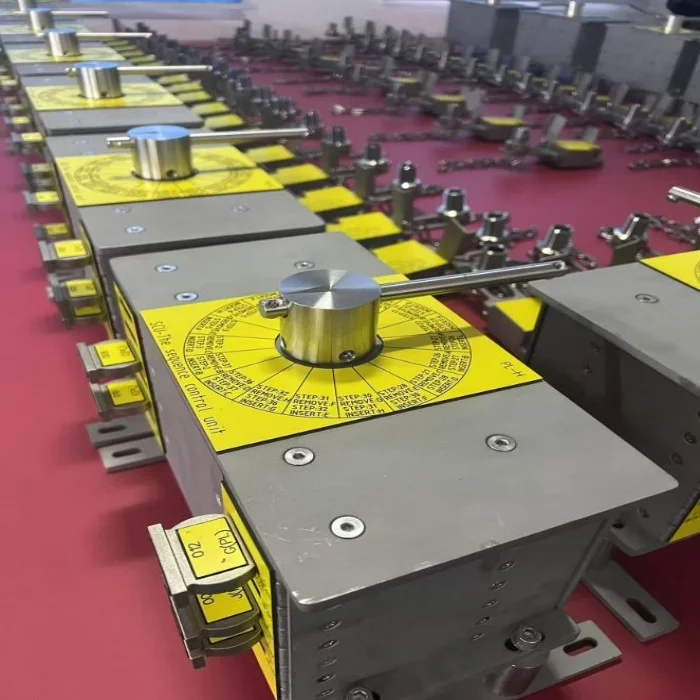
- Define the interlock logic: Do you need a simple single‑valve lockout or a sequential valve interlock system that forces a specific operating order? Nudango’s Sequential Control Unit (SCU) can manage complex sequences across multiple valves.
- Choose between standard or customized: If your valve body has non‑standard dimensions or mounting points, a customized valve interlock solution (like Nudango’s bespoke designs) will ensure reliable operation.
- Verify certifications: Ensure the interlock carries relevant certifications (ISO 9001, CE) and is designed for the required ATEX/IECEx zone if used in explosive atmospheres.
5. Use Cases: Real-World Applications
Case 1: Gas Terminal Ball Valve Isolation
A European oil & gas operator needed to interlock two 12-inch ball valves to prevent simultaneous opening. They deployed Nudango’s Rotary motion valve interlocking (Model VJ) in a sequential arrangement. The solution reduced human error by 95% and passed CE audit.
Case 2: Refinery Gate Valve Sequencing
A petrochemical plant in Saudi Arabia required a multi-turn interlock for a 24-inch gate valve used in catalyst loading. Nudango supplied a custom Multi-turn valve interlock (model VDL) with a stainless steel enclosure, ensuring reliable operation under sand and heat.
6. Frequently Asked Questions (FAQ)
Q: What is a valve interlock system?
A: A valve interlock system is a mechanical safety device that prevents operators from operating a valve out of sequence or without authorization. It uses a unique key to lock the valve in a specific position and releases the key only when the valve is in the correct state.
Q: Can I use a quarter-turn interlock on a gate valve?
A: No. Quarter-turn interlocks are designed for 90° rotation only. Using them on multi-turn valves will cause mechanical damage and safety compromise. Always match the interlock type to the valve’s rotational characteristic.
Q: How do I choose between standard and customized valve interlock?
A: If your valve complies with common dimensions (e.g., ISO 5211 pad or standard stem height), a standard model is cost-effective. For legacy valves, special mounting or non‑standard turn angles, order a customized valve interlock solution from a manufacturer like Nudango that offers engineering support.
Q: What certifications should I look for?
A: For global projects, demand ISO 9001 quality management, CE marking (for EU), and if in explosive zones, ATEX or IECEx certification. Nudango’s products carry these certifications, including CE and tri‑system management certificates (Quality, Environment, Health & Safety).
7. Conclusion
Choosing between a quarter-turn valve interlock and a multi-turn valve interlock is a straightforward decision once you know your valve type and operational context. For safety-critical applications, always involve a reliable supplier with proven expertise in mechanical valve interlock systems. Shanghai Nudango Safety Equipment Co., Ltd. (Nudango) offers a comprehensive range of products—from the compact VJ rotary interlock to the robust VDS/VDL multi-turn devices—backed by ISO and CE certifications. Their Sequential Control Unit (SCU) can tie multiple interlocks together for complex process logic. By following the step‑by‑step guide above, procurement professionals can confidently select the correct interlock, reduce downtime, and enhance plant safety.
Nudango – Safe Operation, Reliable Interlocking
No.124, Block C, No.1118 Guchen Road, Baoshan District, Shanghai, P.R.C.
Email: globalnudango@shndg.cn | Phone: +86 13052019523 | WhatsApp: +86 13816485040